
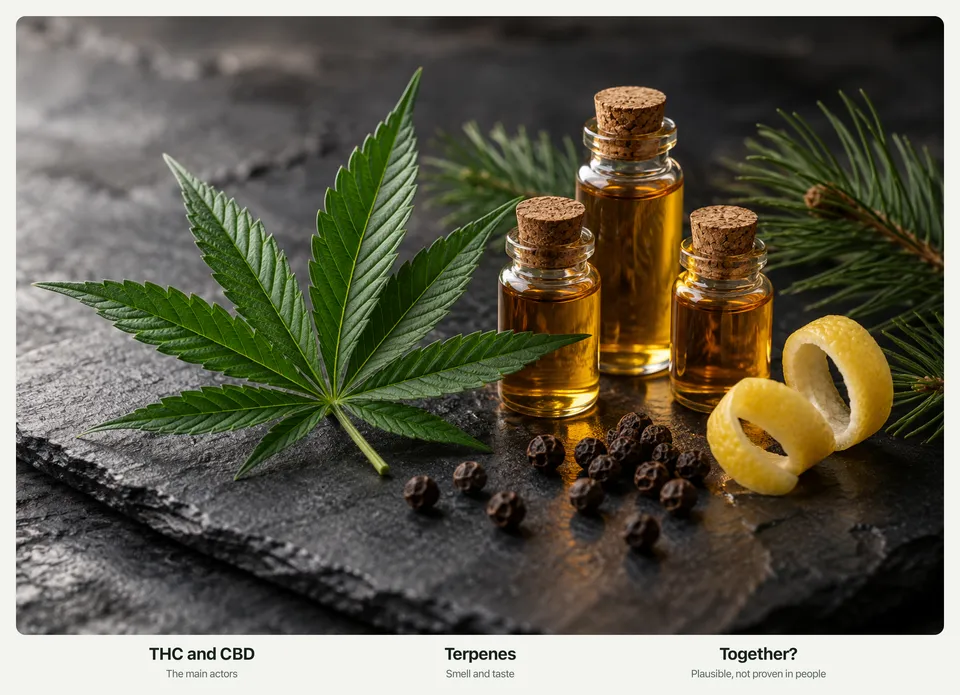
The entourage effect is the idea that the many compounds in cannabis, mainly THC, CBD, other cannabinoids and the aroma compounds called terpenes, work together to produce effects that none of them produce alone. It began as a scientific hypothesis in 1998 and became a selling point for "full spectrum" products.
The honest status: plausible, popular, and not proven in people. Recent reviews call the evidence thin and contradictory. A 2023 controlled trial found that adding CBD at the ratios common in stores did not soften THC's effects. How much THC you take is still the thing to watch.
Contents8
Entourage effect meaning, in simple terms
Cannabis flower contains over a hundred cannabinoids (THC and CBD are the famous ones) plus terpenes, the compounds that make one strain smell like lemon and another like pine. The entourage effect says the whole mix matters: that the minor compounds nudge, soften or boost what THC does, so smoking flower or using a full-plant extract feels different from taking pure THC. Supporters give two examples: CBD taking the edge off THC, and terpenes like pinene or limonene changing the character of a high.
Where the idea came from
The phrase was coined in 1998 by a research group that included Raphael Mechoulam, the chemist who first isolated THC. They weren't writing about the plant at all. In lab tests on mice and tissue, they found that inactive molecules made by the body boosted one of the body's own cannabinoids. They called the helpers an "entourage." In 2011 the neurologist Ethan Russo published a long review titled "Taming THC" arguing the same thing might be true inside the plant, proposing which terpenes might do what. Since then, many reviews, articles and ads have promoted the idea. Russo himself called it "potential" synergy that still had to be proven, and he proposed experiments to test it.
What the evidence says
Fifteen years on, there are still few human trials, and some of the scientists who reviewed the evidence are blunt about it.
- A 2020 review in a clinical pharmacology journal concluded that claims of an entourage effect "invoke ill-defined and unsubstantiated pharmacological activities" that are "commonly leveraged toward the popularization and sale" of products.
- A 2023 review in the journal Biomedicines found existing studies "based on simplistic methodologies" with "contradictory findings," and the clinical evidence "mostly relying on anecdotal and real-world evidence."
That's not the same as saying it's false. Lab and animal work shows some of these compounds do interact. It means the human trials have only just started. In a 2024 trial, 20 adults inhaled THC with and without vaporized limonene, the lemon-scented terpene. The highest limonene dose, tested in 12 of them, lowered ratings of feeling anxious and paranoid after a strong dose of THC. Nothing else about the high changed. One small lab study is a start. It doesn't mean a lemony strain will calm you down.
Does CBD tame THC?
This is the one piece that has been tested properly, because it matters for every "1:1" or "CBD-rich" product on a shelf. A 2013 study gave 48 people either a large dose of CBD by mouth or a placebo, then THC through a vein. The CBD group had less paranoia, and that result was widely repeated. But nobody uses cannabis that way. In 2023, a trial in the journal Neuropsychopharmacology tested something closer to real use. Forty-six infrequent users each inhaled vaporized cannabis four times, with 10 mg of THC and either 0, 10, 20 or 30 mg of CBD, in random order, without knowing which. THC hurt memory and caused psychosis-like symptoms, such as suspicious or unusual thoughts. In the authors' words, those effects "were not significantly modulated by any dose of CBD." CBD also didn't change how high, anxious or paranoid people said they felt. Their conclusion: at the ratios found in real products, "no evidence that CBD protects against the acute adverse effects of cannabis."
So a CBD-heavy product may feel milder mainly because it has less THC in it. Health Canada still suggests new users choose products with a low amount of THC and an equal or higher amount of CBD. The low THC is the part the evidence backs. If you're already too high, don't count on CBD to bring you down. The too high page has what helps.
What does the entourage effect feel like?
Nobody can tell you, and that's the point. People report that different strains feel different, but trials have barely begun to tie a feeling to a specific compound. Flavor and smell are real and come from terpenes. "Energizing" or "relaxing" labels on a jar are tradition and marketing. Our first-time guide explains why indica and sativa labels don't predict effects either. What matters most is how much THC you take, how you take it, and your own tolerance. Health Canada notes that higher amounts of THC can cause more impairment.
What it means when you buy
- Full spectrum vs. distillate is mostly a flavor choice. No trial has shown that either one is safer or gives a better high. Live resin tastes more like the plant; distillate tastes like little. Their THC numbers can differ a lot, so compare the label on each.
- The THC number is the number. A 25% flower with a great terpene chart is still 25% flower.
- Don't count on CBD to cancel out THC. The 2023 trial found it didn't, at the ratios common in stores. Less THC is what makes a product gentler.
- Terpene percentages on a label tell you about smell. Claims about how a terpene will make you feel are still mostly unproven.
Words you'll hear
- Cannabinoids: the family of compounds that includes THC and CBD.
- Minor cannabinoids: the less common ones: CBG, CBN, CBC, THCV. CBG is sometimes marketed as "the mother of all cannabinoids" because the plant makes the others from its acid form.
- Terpenes: the aroma compounds, also found in citrus, pine and lavender.
- Full spectrum: an extract that keeps most of the plant's compounds. Broad spectrum: most, with THC removed. Isolate: one compound, usually CBD or THC.
- Synergy: the technical word for "more together than apart."
Common questions
What is the entourage effect in simple terms?
The idea that the compounds in cannabis, THC, CBD, other cannabinoids and terpenes, work better together than any one of them alone. It's a hypothesis from 1998 that became a marketing term. Reviews in 2020 and 2023 found it unproven in people.
What does the entourage effect feel like?
There's no tested answer. People say strains feel different, and terpenes change the smell and taste, but trials have barely begun to link a feeling to a specific compound. How much THC you take matters most.
Is the entourage effect real?
Partly. Some cannabis compounds interact in lab and animal studies, so the idea isn't silly. But a 2020 review called the claims unsubstantiated and marketing-driven, and a 2023 review found the human evidence thin and contradictory. Treat it as a hypothesis.
Does CBD reduce the effects of THC?
Not at the ratios common in stores, according to a 2023 randomized trial. With the same amount of THC, adding up to three times as much CBD did not change the memory problems, the psychosis-like symptoms, or how high or anxious people felt. A CBD-rich product may feel milder mainly because it has less THC.
Does the entourage effect help with anxiety?
It isn't proven. One small 2024 trial found that adding a high dose of limonene to THC lowered ratings of feeling anxious, but one study is not proof, and no terpene or CBD product is a treatment. If cannabis makes you anxious, use less THC, and if it's happening now, see the too high page.
What is the "mother of all cannabinoids"?
CBG, or rather its acid form CBGA, which the plant converts into THCA, CBDA and others. It's a nickname from marketing, not a measure of effect. CBG is a minor cannabinoid, usually present in small amounts.
How do you get the entourage effect?
Using flower or a full-spectrum extract gives you the full mix of compounds, which is what the idea describes. Whether that changes the effect beyond flavor hasn't been shown. Don't take more THC chasing it.
Are terpenes what make a strain feel different?
They make it smell and taste different, and in lab studies some terpenes act on the body. Human trials have barely begun. One small 2024 trial found a high dose of limonene lowered THC's anxious feelings, but one study is not proof. Strain names and "relaxing" labels are not reliable guides.
We cite government health agencies and peer-reviewed research. Numbers in the text link to the source.
- Peer-reviewed Russo (2011): Taming THC, potential cannabis synergy and phytocannabinoid-terpenoid entourage effects, British Journal of Pharmacology
- Peer-reviewed Cogan (2020): The entourage effect or hodge-podge hashish, Expert Review of Clinical Pharmacology
- Peer-reviewed Christensen et al. (2023): Decoding the postulated entourage effect of medicinal cannabis, Biomedicines
- Peer-reviewed Englund et al. (2023): Does cannabidiol make cannabis safer? A randomised trial of four CBD:THC ratios, Neuropsychopharmacology
- Government Health Canada: Lower your risks
- Peer-reviewed Spindle et al. (2024): Vaporized D-limonene selectively mitigates the acute anxiogenic effects of THC in healthy adults, Drug and Alcohol Dependence