
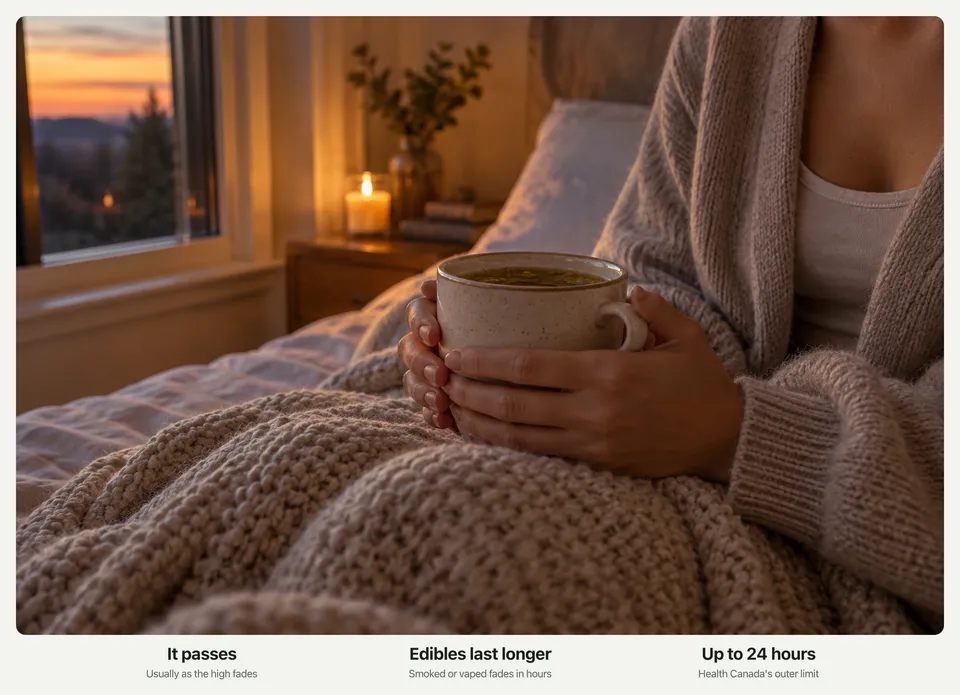
Anxiety or panic brought on by cannabis usually fades as the high fades, often within a few hours for smoked or vaped cannabis and longer for edibles. Health Canada says effects of either can last up to 24 hours, but the worst of the panic, the racing heart and the sense that something is badly wrong, usually passes well before that.
Some people feel shaky or uneasy for a day or two afterward. That usually fades too. If anxiety keeps returning when you're sober, or you had hallucinations or lost touch with reality, that's a reason to talk to a doctor. If you're anxious right now, the too high page has the steps.
Contents9
How long cannabis anxiety lasts
Two clocks. The first is the drug. Health Canada's numbers: inhaled cannabis is felt within seconds to minutes and its effects can last up to 24 hours; eaten cannabis starts in 30 minutes to 2 hours and can also last up to 24 hours. Most of that tail is mild. The strong part of a smoked high is usually over in a couple of hours; an edible's peak comes later and lasts longer, which is why edible anxiety feels endless. The panic rides that curve and comes down with it.
The second clock is you. After a frightening episode, people often describe days of feeling on edge, sleeping badly, and bracing for it to come back. That can follow a panic attack from any cause, and for most people it fades. Few studies have timed cannabis anxiety. One 2023 study of 196 emergency room patients with cannabis-induced anxiety found that half had symptoms for about 6 hours or less, and a quarter for more than about 12. Those were people scared or sick enough to go to the hospital. What the studies show more clearly is who it happens to and why.
Why weed causes anxiety
THC's effect on mood depends on the dose. A 2020 review found that human studies show "a common anxiogenic response to THC," especially at higher doses. Anxiogenic means anxiety-causing, so: more THC, more anxiety. NIDA, the US drug research agency, lists anxiety, fear, distrust and panic among cannabis's short-term effects and says they are "more common when a person takes a large amount, the cannabis product is strong (has a high level of THC), or the person has little experience with using cannabis."
That's three of the four usual ingredients. The fourth is setting: a crowded party, a stranger's couch, or a first time alone with nobody to tell you it's fine. Put them together, a strong product, a big dose, a new user and a tense room, and the body does what it does under threat. Heart rate climbs, thoughts speed up, and the mind reads the physical symptoms as danger.
Cannabis-induced anxiety and panic attack symptoms
- A pounding or racing heart. THC raises heart rate on its own; panic adds to it. Some people fear they're having a heart attack. In the 2023 emergency room study, panic attacks were the most common feature among patients with cannabis anxiety.
- Dread and paranoia. A sense that something is wrong, that people are watching, or that the feeling will never end.
- Physical symptoms: sweating, shaking, nausea, tight chest, numb or tingling hands, dizziness.
- Looping thoughts about the symptoms themselves. The fear of the panic feeds the panic.
For most healthy people, none of that is dangerous on its own, though Health Canada notes a faster heart rate can be risky for people with heart conditions. The CDC puts anxiety, paranoia and panic on its list of signs of having used too much, alongside fast heart rate and nausea, and notes that a fatal overdose from cannabis alone is unlikely.
What to do right now
- Stop taking more. Nothing you add helps; the exception is water and a snack.
- Tell someone you're having a rough high. Saying it out loud takes a layer off.
- Change the room. Dim, quiet, cool. Sit or lie down. Put on something familiar.
- Breathe slowly, longer out than in. The too high page has a pacer and the full set of steps.
- Remind yourself of the clock. It peaks and passes. Edibles take longer; that is the drug's timeline, not a sign it's getting worse.
When to call for help
Call 911 if someone has chest pain that doesn't ease, trouble breathing, a seizure, or can't be woken. Poison Control is free at 1-800-222-1222 for anything short of that, including "is this normal." Hallucinations or losing touch with what's real can happen at high doses; NIDA describes temporary psychotic episodes in some people. They usually pass with the drug, and they're a reason to see a doctor afterward.
Anxiety the next day, and the week after
Feeling fragile for a day or two after a panic episode is normal. Sleep, food, a walk, and not re-testing yourself with another session that week are the sensible moves. Most people are back to baseline within days. See a doctor or therapist if the anxiety keeps returning while sober, if you're avoiding things you used to do, or if it's been more than a couple of weeks. Health Canada notes that people with a personal or family history of mental health conditions are at higher risk from cannabis, and that daily or near-daily use over time raises the chance of developing anxiety and depression disorders. A single bad night isn't a disorder, but a pattern is worth a conversation.
Does weed help with anxiety?
Many people use it that way, and in the moment a small amount can feel calming. The evidence for using it as a treatment is weak, and the regulators are blunt. Health Canada: "cannabis use has not been found to improve mental health over time," and frequent use increases the chance of anxiety and depression disorders. The 2020 review found THC tends toward anxiety at higher doses, that CBD reduced anxiety acutely in small studies, and that real trials in people with anxiety disorders are still needed. A 2023 trial, covered on our entourage effect page, found that adding CBD at the ratios common in products did not reduce THC's acute effects. If anxiety is a problem in your life, that's a conversation for a doctor, not a dispensary. This site doesn't give medical advice.
Who should be especially careful
- Anyone new, or trying a stronger product than usual. Inexperience and strength are two of NIDA's three risk factors.
- People with a history of panic attacks or anxiety disorders. In the emergency room study, patients with cannabis anxiety were more likely to have another mental health condition.
- Anyone with a personal or family history of psychosis or schizophrenia. Health Canada and NIDA both name this group, especially young men.
- Edible users who redose. Taking more at 45 minutes because "nothing's happening" is a common way edible panics start. The edibles guide has the clock.
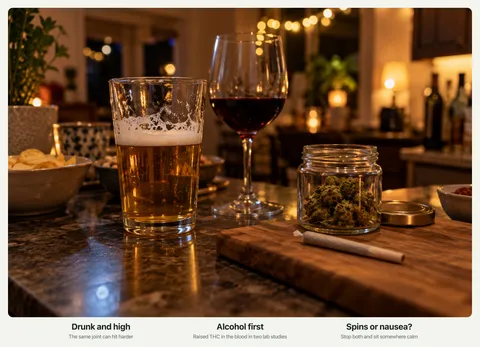
- Anyone mixing with alcohol. See crossfaded.
Words you'll hear
- Greening out, whitey: the pale, sweaty, nauseated state from too much cannabis. Often comes with panic.
- Paranoia: the feeling of being watched or judged; common and temporary during a high.
- Set and setting: your mood and your surroundings, which shape how a high goes.
- Cannabis-induced anxiety disorder: a diagnosis for anxiety or panic during or soon after cannabis use that is bad enough to cause real distress; a doctor's call, not a self-diagnosis.
- Tolerance break: time off to reset. a common choice after a bad experience, and not a bad one.
Common questions
What does cannabis-induced anxiety feel like?
A racing heart, dread, paranoia, sweating, shaking, nausea and looping thoughts about the symptoms. Some people fear they're having a heart attack. It's frightening, but for most healthy people it isn't dangerous by itself, and it passes with the high.
How long does edible anxiety last?
Longer than from smoking, because edibles start late and peak late. Health Canada says eaten cannabis starts in 30 minutes to 2 hours and effects can last up to 24 hours. The strongest stretch is usually a few hours in the middle. Don't take more while you wait.
Can edibles trigger a panic attack?
Yes. Edibles can take 30 minutes to 2 hours to kick in, so people often take more before the first dose arrives. In a 2023 study of emergency room visits, patients with cannabis-induced anxiety were more than twice as likely to have eaten an edible as other cannabis patients (26% vs. 11%).
How long does it take to recover from a bad high?
The high itself fades within hours, up to a day for edibles. Feeling shaky or on edge for a day or two afterward is common after any panic episode. If anxiety keeps coming back sober, or lasts more than a couple of weeks, see a doctor.
Why does weed give me anxiety now when it didn't before?
Often the product got stronger, the dose got bigger, or your life got more stressful. THC's effect depends on dose and setting, and today's flower and concentrates are far higher in THC than they were. A smaller amount of a weaker product in a calm place changes the odds.
Does CBD help with weed anxiety?
Not in the amounts found in products: a 2023 trial found adding CBD to THC at store ratios didn't reduce THC's acute effects (see our entourage effect page). Small studies of CBD alone found it reduced anxiety, but that's a different thing from rescuing a high. Less THC is what helps.
Does weed help with anxiety?
Health Canada says cannabis use has not been found to improve mental health over time, and that daily use raises the risk of anxiety and depression disorders. The research on THC points the other way at higher doses. Talk to a doctor; this site doesn't give medical advice.
We cite government health agencies and peer-reviewed research. Numbers in the text link to the source.
- Government Health Canada: Health effects of cannabis (onset and duration, anxiety and panic)
- Government Health Canada: Cannabis and mental health
- Government NIDA (NIH): Cannabis (marijuana), short-term effects and risk factors
- Government CDC: Cannabis FAQs (signs of using too much, Poison Control, 911)
- Peer-reviewed Sharpe et al. (2020): Cannabis, a cause for anxiety? A critical appraisal, Journal of Translational Medicine
- Peer-reviewed Keung et al. (2023): Cannabis-induced anxiety disorder in the emergency department, Cureus